
Method & learning
Learn German fast online and for free: the complete A1 → B2 method for adults
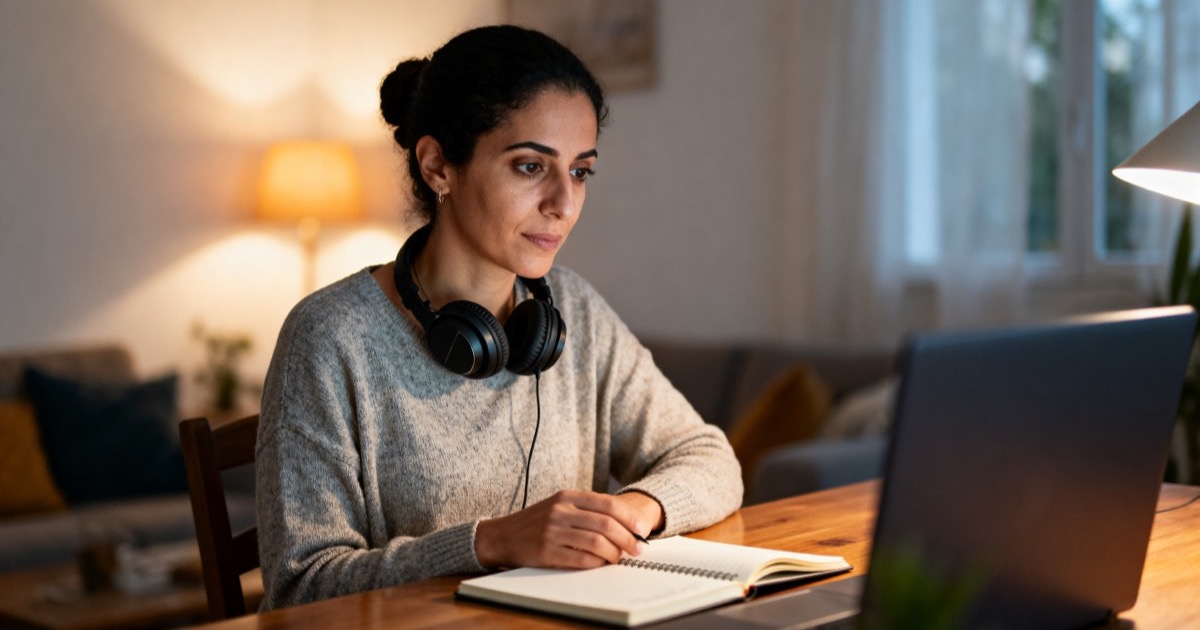
Yes, you can learn German fast, online and for free — provided you stop collecting apps and follow a structured pathway. For an adult starting from scratch, reaching B1 takes roughly 350 to 400 hours of guided learning, and B2 roughly 600 to 700 hours. At 45 minutes a day, that works out at about 8 months for B1 and 14 months for B2. Here is the method that lets you hold that pace without paying for private lessons.
Key takeaways
- Allow roughly 350-400 hours to reach B1 and 600-700 hours for B2 starting from zero.
- Consistency beats intensity: 45 minutes every day gets you further than 5 hours on a Sunday.
- A structured A1 → B2 platform beats a collection of apps, because it prevents gaps in your grammar.
- Speak from week one: oral production is the slowest skill to develop and the most often neglected.
- Learn your occupational vocabulary alongside the core course: that is what makes German useful straight away.
How long does it really take to learn German?
German is a moderately difficult language for a French or Arabic speaker: the grammar is more demanding than English (cases, verb position), but the vocabulary and alphabet are familiar. Language-institute frameworks converge on fairly stable hour counts, provided the learning is guided — that is, structured, corrected and progressive — rather than passive exposure.
| Level | Cumulative hours | At 45 min/day | What you can do |
|---|---|---|---|
| A1 | ~80-100 h | ~3 months | Introduce yourself, ask simple questions, follow everyday basics |
| A2 | ~180-200 h | ~5 months | Handle everyday situations: shopping, appointments, transport |
| B1 | ~350-400 h | ~8 months | Work, understand instructions, sustain a conversation |
| B2 | ~600-700 h | ~14 months | Argue a point, read technical texts, work in a skilled job |
The key word here is "guided". Watching German videos without structure does not count towards that total: it is an excellent supplement, but it does not replace an ordered grammatical progression. That is precisely why so many adults stall at A2 for years.
The 7-step method to progress quickly
Speed does not come from a trick, but from eliminating wasted time: skipped levels, badly timed revision and, above all, those months spent reviewing vocabulary without ever speaking. Here is the order that works.
- 1Set a dated, concrete goal: "certified B1 by June to apply for an Ausbildung" is a goal; "learn German" is not.
- 2Pick one structured A1 → B2 platform and stick with it: switching tools every month recreates the same gaps.
- 3Block a fixed 45-minute slot in your day, always the same one — it is habit, not motivation, that carries you through a year.
- 4Work on all four skills from the start: reading, listening, writing, speaking. Never push speaking back to "later".
- 5Memorise vocabulary with spaced repetition rather than word lists: 15 minutes a day is enough for 20-30 new words.
- 6Add your occupational vocabulary in parallel (care work, technical, construction, logistics): that is what makes the language immediately useful.
- 7Test your level every 4 to 6 weeks to correct course before a grammar gap sets in.
The 5 mistakes that cost you months
- Collecting free apps without finishing any of them: you feel busy, but you keep redoing level A1.
- Putting off speaking: it is the slowest skill to acquire, and the one assessed both in exams and in interviews.
- Learning word lists out of context: a word learned inside a sentence gets reused; an isolated one is forgotten in three days.
- Ignoring the case system early on: it looks secondary at A1, then blocks you completely at B1 if you never worked on it.
- Studying in English when you are a French or Arabic speaker: routing through a third language slows the whole process down.
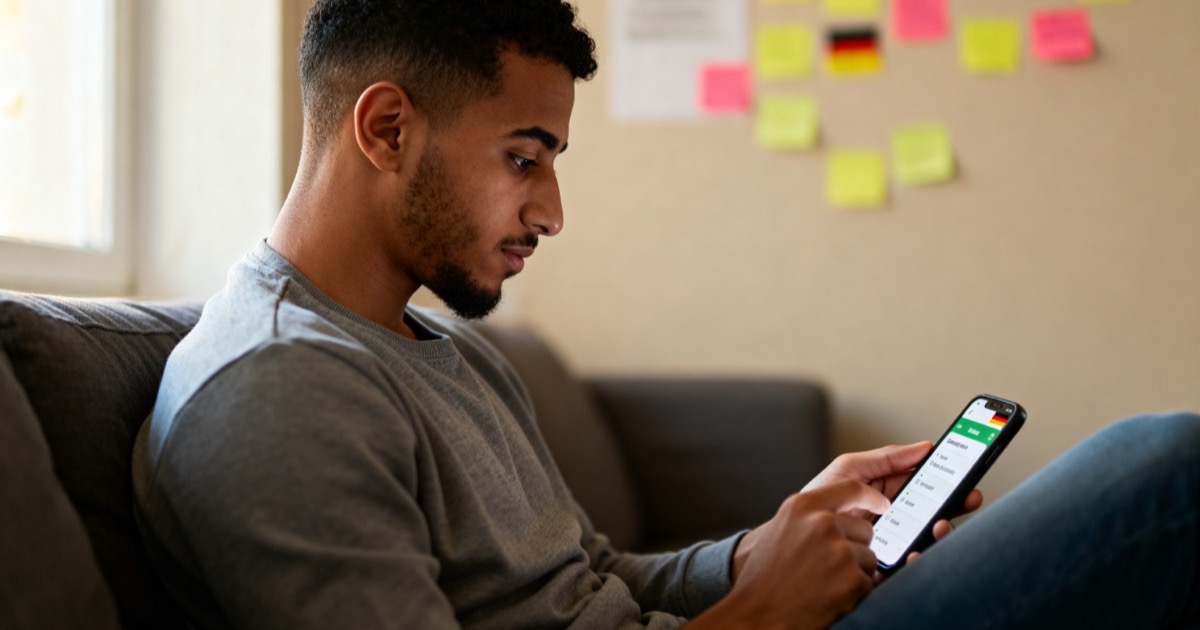
Free, paid or private lessons: which should you choose?
The question is not "free or paid" but "structured or not". A private lesson at 200 dirhams an hour is excellent for unlocking your speaking, and completely useless if you do nothing between sessions. Here is how the options genuinely available to an adult compare.
| Option | Cost | A1→B2 structure | Speaking | Who it suits |
|---|---|---|---|---|
| Structured free platform (Devoxa) | Free | Complete | Yes, via AI tutor | Self-directed adults who want a complete pathway |
| Vocabulary apps | Free / freemium | Partial | Weak | A memorisation supplement, not a pathway |
| Language institute | ~400-1,200 MAD/month | Complete | Yes, in groups | People who need an imposed framework |
| Private German lessons | ~150-350 MAD/hour | Variable | Excellent | Unlocking speaking or preparing a specific exam |
| Videos and podcasts | Free | None | Passive | A listening supplement once you reach A2 |
The most effective — and cheapest — combination: a structured free platform as your daily base, plus German podcasts from A2 onwards to train your ear. Private lessons become worthwhile occasionally, in the six weeks before an exam.
A realistic 45-minute daily plan
Here is the split that produces the best results in a single daily session. It fits into a lunch break or an evening commute.
- 10 min — review yesterday's flashcards with spaced repetition
- 20 min — one structured lesson from the pathway (grammar plus exercises)
- 10 min — speaking: read aloud, answer the AI tutor, repeat a dialogue
- 5 min — write three sentences using the day's vocabulary and have them corrected
At the weekend, swap the lesson for a longer listening session: a podcast episode, a simplified German news bulletin, a free conversation. That is what turns knowledge into reflex.
What is the best site to learn German for free?
Most free platforms stop at A2, or lock advanced grammar behind a subscription. Devoxa was designed the other way round: a complete A1 → B2 pathway, in French and Arabic, entirely free, and aimed at a professional goal — working or training in Germany.
- Structured A1 → B2 pathway: 96 chapters, with no level locked behind a subscription
- Bilingual French/Arabic AI tutor to practise speaking, correct your writing and explain any rule 24/7
- Spaced-repetition flashcards (SM-2 method) and vocabulary by profession
- Preparation for the telc and Goethe exams, with practice on all four papers
- Regular level tests and progress tracking so you can adjust your pace
- No bank card, no time limit, usable on mobile and desktop alike
Start your A1 → B2 pathway for free, today
Start for freeAbout the author
Devoxa Teaching Team
The Devoxa teaching team brings together German teachers, native speakers and specialists in the Morocco → Germany professional immigration path. Our content is built on the Common European Framework of Reference (CEFR) and on the real requirements of the TELC and Goethe-Zertifikat exams, so every guide is reliable, up to date and immediately useful.
Frequently asked questions about learning German quickly online
Can you learn German for free online all the way to B2?
Yes. The grammar and vocabulary content of an A1 → B2 pathway is available free on a structured platform such as Devoxa. The one unavoidable cost is the certification exam (Goethe, telc or ÖSD), which runs to roughly 1,800-2,700 MAD in Morocco depending on the level.
How long does it take to learn German quickly?
Starting from zero, allow roughly 350-400 hours of guided learning for B1 and 600-700 hours for B2. At 45 minutes a day, that is about eight months for B1 and fourteen months for B2. Doubling your daily pace shortens the timeline, but consistency still matters more than intensity.
What is the best site to learn German for free?
The best site is one that offers a complete A1 → B2 pathway without locking the advanced levels behind a subscription, and that lets you practise speaking. Devoxa covers all four skills in French and Arabic, with an AI tutor available around the clock and preparation for the telc and Goethe exams.
Is German hard to learn as an adult?
German is moderately difficult for a French speaker: the pronunciation is regular and the vocabulary often transparent, but the case system and verb position demand rigour. An adult does have a real advantage over a child, though: they grasp grammar rules explicitly, which noticeably speeds up the early levels.
Do you need private German lessons?
They are not essential for progress, but they are very effective on two specific points: unlocking your speaking and preparing for an exam in the six weeks before it. The rest of the time, a structured daily pathway produces better results at no cost.
How many words do you need to reach B1?
You need roughly 2,500-3,000 active words for B1 and 4,000-5,000 for B2. At 20-30 new words a day with spaced repetition, B1 vocabulary takes four to six months — provided you learn them in context, inside sentences, rather than in isolated lists.
Can you learn German in 3 months?
In three months of daily work, an adult beginner reaches a solid A1 and sometimes the start of A2: enough to introduce yourself, ask simple questions and handle daily life. B1, which is required for a training visa, takes roughly eight months at the same pace. Be wary of promises of B1 in three months.
Is it better to learn German in French or in English?
Learn in your strongest language. For a French or Arabic speaker, going through English-language material adds needless cognitive load and slows down how quickly the grammar sinks in. A platform that explains German directly in French or Arabic saves you several weeks.