
Studying in Germany
Studying in Germany from Morocco: universities (often free), requirements, student visa, and budget (2026)
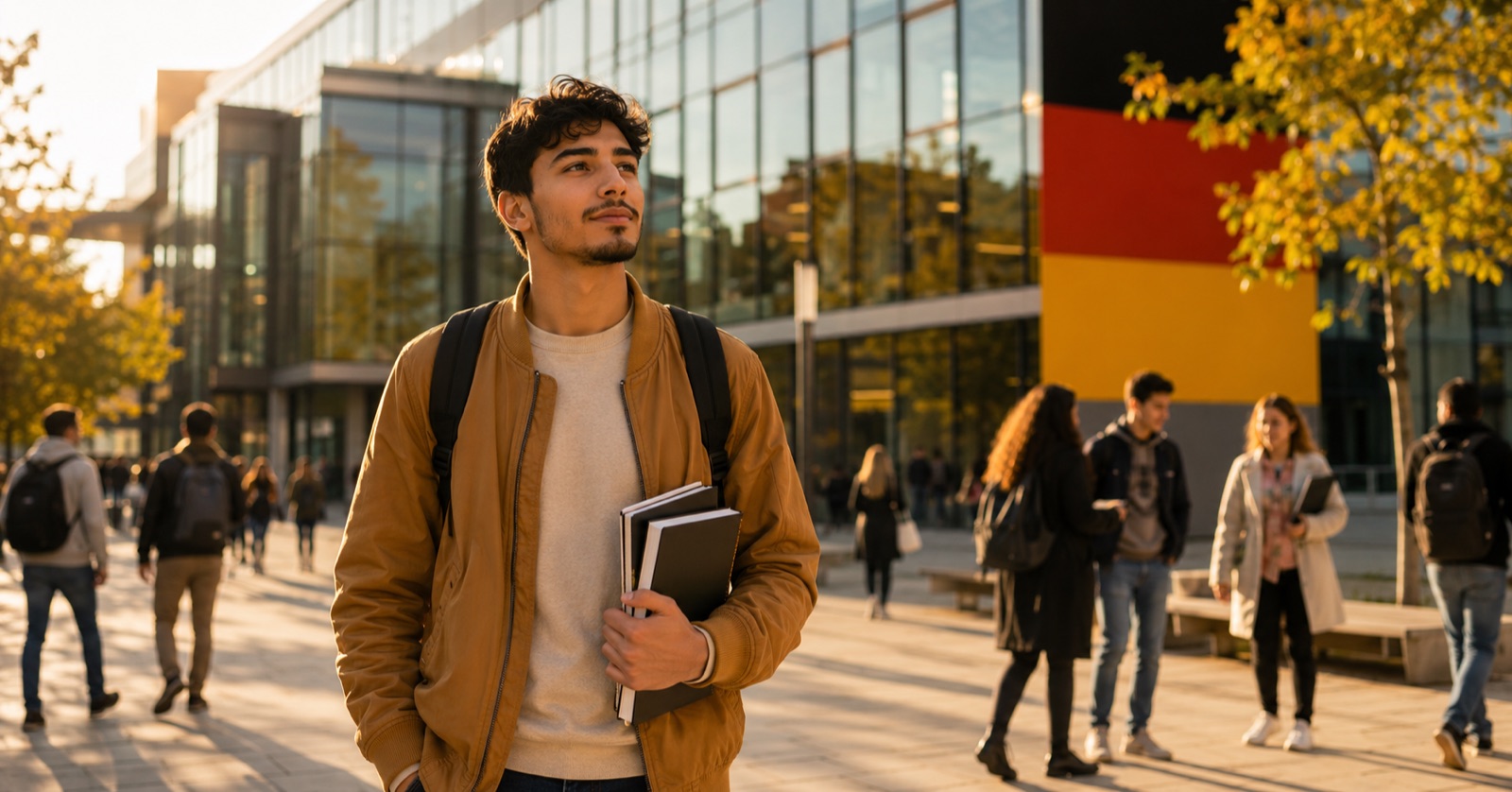
Yes, you can study in Germany from Morocco — and at a public university, with no tuition fees, just a semester contribution of around 150 to 350 €. The path is clear: reach the required German language level (often B2–C1), go through the mandatory APS procedure for Moroccan high school graduates, get admission (direct or via a Studienkolleg), open a blocked account (Sperrkonto) of approximately 11,904 € for the year, then submit your student visa application to the German embassy in Rabat. This guide explains each step, with indicative figures for 2026.
The Essentials
- German public universities are almost free: no tuition fees, only a semester contribution of around 150 to 350 € (indicative for 2026).
- The APS (Akademische Prüfstelle) procedure is mandatory for Moroccan high school graduates before applying.
- Depending on your Abitur, you either enter university directly or first attend a Studienkolleg (preparatory year).
- German language level: generally B2–C1, proven by TestDaF or DSH for German-taught programs (some Master's degrees are in English).
- For a student visa, you need a blocked account (Sperrkonto) of approximately 11,904 € per year (≈ 992 €/month), deposited at the German embassy in Rabat.
Why Study in Germany from Morocco?
Germany is one of the few major destinations where public universities are tuition-free, even for international students. Add to that globally recognized degrees, cutting-edge research, a labor market with a shortage of skilled workers, and the right to work while studying, and you have an ideal destination for an ambitious Moroccan student. Programs range from Bachelor's to Master's, and even PhDs, in almost all disciplines: engineering, computer science, medicine, economics, and humanities.
- Public universities with no tuition fees — only a modest semester contribution
- Degrees (Bachelor, Master) recognized throughout the European Union and beyond
- Right to work while studying (up to 140 full days or 280 half-days per year)
- Many Master's programs taught entirely in English
- Option to stay and look for a job for 18 months after graduation
Are German universities really free?
For the most part, yes. In public universities (most Länder), there are no tuition fees for Bachelor's and Master's studies. You only pay a Semesterbeitrag which covers administration and often a public transport pass. Be aware: the state of Baden-Württemberg charges around 1,500 € per semester for non-EU students, and private universities charge full tuition fees.
| Criterion | Public University | Private university |
|---|---|---|
| Tuition fees | None (except Baden-Württemberg ~€1,500/semester) | Paid: ~€5,000 to €20,000/year |
| Semester contribution | ~€150 to €350 | Variable, often included |
| Language of instruction | German (B2–C1), some Master's degrees in English | Often English or bilingual |
| Admission | Selective, via APS then uni-assist / university | More flexible, direct application |
| Monthly cost of living | ~934 €/month (indicative average) | ~934 €/month (indicative average) |
Admission requirements from Morocco: APS and Studienkolleg
For Moroccan high school graduates, two concepts are essential: APS and, sometimes, the Studienkolleg. The APS (Akademische Prüfstelle, an academic evaluation service attached to the German embassy) verifies the authenticity of your diplomas and your eligibility. The APS certificate is now mandatory for most applications and for the visa. Without an APS, your application will not be accepted — so start this process very early.
The Studienkolleg is a preparatory year. The Moroccan baccalaureate alone does not always grant direct access to German universities: depending on your field of study and your grades, you may need to attend a Studienkolleg, which concludes with an exam (Feststellungsprüfung) that grants access to studies. If your application is directly admissible, you can enter without this step.
- APS mandatory: submit your application to the APS service at the German embassy, with diplomas and transcripts
- Studienkolleg: preparatory year if your baccalaureate is not directly admissible, concluded by the Feststellungsprüfung
- Applications via uni-assist or directly to the university depending on the course of study
- Certified translations of your diplomas (German or English)
- Proof of German proficiency (or English for English-language programs)
What German level do you need to study?
For a degree program taught in German, you generally need a B2 to C1 level, proven by an official exam: the TestDaF or the DSH. The TestDaF (Test Deutsch als Fremdsprache) can be taken in Morocco, particularly in Casablanca and Rabat, while the DSH is most often taken at the host university in Germany. Some master's programs are entirely in English and require an English test (IELTS or TOEFL) instead.
- German-taught programs: B2–C1 level required, often C1
- Accepted exams: TestDaF (TDN 4 level in all 4 sections) or DSH-2
- TestDaF and telc / Goethe can be taken in Morocco: Casablanca, Rabat
- Master's programs in English: IELTS or TOEFL instead of German
- Devoxa builds your A1 → B2 foundation for free before you aim for the TestDaF or DSH
The good news: the longest part of the journey is progressing from A1 to B2. This is exactly where Devoxa supports you — for free, in French and Arabic, with an AI tutor — before you switch to targeted preparation for the TestDaF or DSH.
Budget, cost of living, and blocked account (Sperrkonto)
To get a student visa, Germany requires proof that you can support yourself for one year. The most common method is the blocked account (Sperrkonto): you deposit a state-mandated sum, which is released monthly once you're in Germany. In 2026, the indicative amount is approximately 11,904 € per year, or about 992 € per month. In addition, you'll need mandatory health insurance and the semester contribution.
- Blocked account (Sperrkonto): ~11,904 € / year (≈ 992 €/month), released monthly
- Mandatory student health insurance: ~120 €/month
- Rent: from ~250 € (student dorm room / Studentenwerk) to ~500 € and more in a large city
- Semester contribution: ~150 to 350 €
- Student work permitted: up to 140 full days or 280 half-days per year to supplement your budget
Scholarships are also available to lighten the load: the DAAD (German Academic Exchange Service) funds many international students, and other foundations offer aid based on merit or project. In some cases, a scholarship can replace or supplement the blocked account as proof of funds.
Student visa: apply in Rabat / Casablanca
Once you've been admitted, you submit your student visa application (Visum zu Studienzwecken) to the German embassy in Rabat (the Casablanca consulate handles other procedures — check where your application should go). Make an appointment well in advance: slots fill up months ahead. Your application includes your admission letter, proof of your blocked account, your APS certificate, proof of your language proficiency, and your insurance.
- University (or Studienkolleg) admission letter
- APS certificate
- Proof of a blocked account (Sperrkonto) of approximately 11,904 €
- Proof of German (TestDaF / DSH) or English proficiency, depending on your program
- Health insurance for your arrival, valid passport, and embassy forms
Studying in Germany step-by-step
Here's the logical order of the process, starting from Morocco, so you don't forget anything and meet deadlines (easily allow 12 to 18 months for preparation):
- 1Achieve German proficiency: go from A1 to B2 with Devoxa, then aim for C1 and pass the TestDaF or DSH (for English-taught programs, pass the IELTS or TOEFL).
- 2Start the APS procedure: submit your diplomas and transcripts to the German Embassy's APS department to get your certificate.
- 3Choose your program and apply: select the university and program, then apply via uni-assist or directly, including a Studienkolleg if your high school diploma doesn't grant direct access.
- 4Get admission: receive the letter of admission (Zulassung) from the university or Studienkolleg.
- 5Open a blocked account (Sperrkonto): deposit approximately 11,904 € and get mandatory health insurance.
- 6Submit your visa application: make an appointment at the German Embassy in Rabat and submit your complete application (admission, APS, Sperrkonto, language, insurance).
- 7Depart and settle in: arrange accommodation (Studentenwerk, WG-Gesucht.de), complete administrative enrollment (Immatrikulation), and start classes.
How does Devoxa prepare you for free?
The number one barrier to studying in Germany isn't the budget or the bureaucracy — it's the language. Devoxa is a 100% free platform, in French and Arabic, that takes you from zero to a solid level before you aim for the TestDaF or DSH.
- Structured A1 → B2 courses, an essential foundation before C1 and TestDaF
- Bilingual French/Arabic AI tutor available 24/7 to explain grammar
- Academic and student life vocabulary for Germany
- Spaced repetition flashcards (SM-2 method) for lasting memorization
- Level tests to measure your progress toward B2
- Completely free, no English prerequisites
Start learning German for free on Devoxa
Register for freeAbout the author
Devoxa Teaching Team
The Devoxa teaching team brings together German teachers, native speakers and specialists in the Morocco → Germany professional immigration path. Our content is built on the Common European Framework of Reference (CEFR) and on the real requirements of the TELC and Goethe-Zertifikat exams, so every guide is reliable, up to date and immediately useful.
Frequently asked questions about studying in Germany from Morocco
Are German universities really free?
In the vast majority of Länder, public universities do not charge tuition fees, even for international students. You only pay a semester contribution of about 150 to 350 €, which often includes a public transport pass. Exceptions: Baden-Württemberg charges about 1,500 € per semester for non-EU students, and private universities are fully fee-paying.
What German level do you need to study in Germany?
For a degree program taught in German, you generally need a B2 to C1 level, proven by the TestDaF (often TDN 4 in all four sections) or the DSH. Some master's programs are entirely in English and require an IELTS or TOEFL instead. Devoxa helps you build the A1 → B2 foundation for free before you move on to targeted preparation.
What are the APS and Sperrkonto?
The APS (Akademische Prüfstelle) is a service attached to the German embassy that verifies the authenticity and eligibility of your Moroccan diplomas; its certificate is mandatory for application and for the visa. The Sperrkonto (blocked account) is an account where you deposit approximately 11,904 € for the year (≈ 992 €/month), released monthly once you are in Germany: this is the proof of funds required for the student visa.
Do you need to attend a Studienkolleg?
It depends on your academic record. The Moroccan Baccalauréat doesn't always grant direct access to German universities. If your field of study and grades aren't sufficient, you'll attend a Studienkolleg, a preparatory year that concludes with an exam (Feststellungsprüfung) which then opens the door to university studies. If your academic record is directly admissible, you can enroll without this step.
Can you work while studying in Germany?
Yes. International students are allowed to work up to 140 full days or 280 half-days per year, without additional authorization. This can help supplement your budget, but it doesn't replace the proof of financial resources required for the visa (the Sperrkonto is still mandatory at the outset).
Where do you apply for a student visa in Morocco?
You apply for a student visa at the German Embassy in Rabat (the Casablanca consulate handles other procedures — check where your application is assigned). Make an appointment several months in advance, as slots are limited. Your application should include your admission letter, the APS certificate, proof of your Sperrkonto, proof of your language proficiency, and your health insurance.